

Villa Driveway Gates
A villa driveway gate is the first boundary between your home and the street, carrying both its security and the first impression of the facade. We make sliding, cantilever sliding and double-leaf swing gates to measure, to suit your opening, the slope of your entrance and the space you have for maneuvering.
01Models
Villa Driveway Gates models
Every model has a code. Sending us the code on WhatsApp is enough to make clear which model we are talking about.
6 models

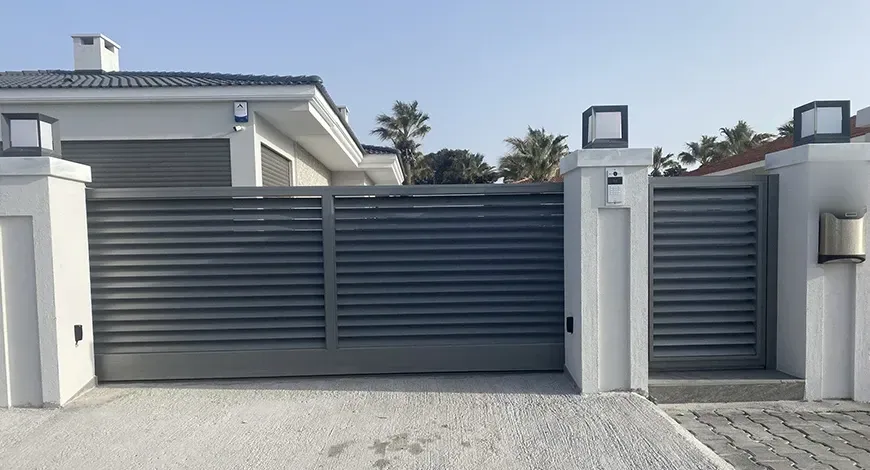
Anthracite Horizontal-Slat Sliding Villa Gate
Villa Driveway Gates · Anthracite gray (RAL 7016)
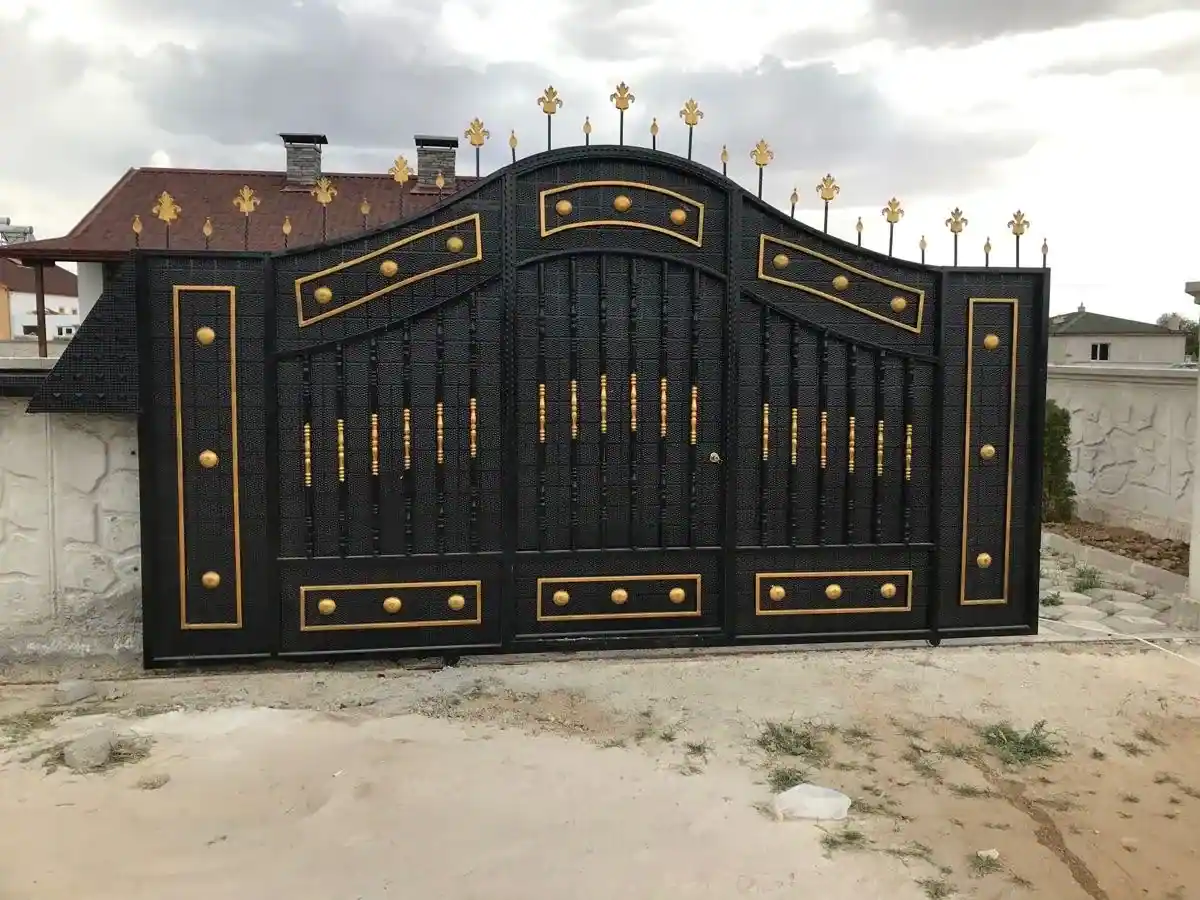
Double-Leaf Wrought Iron Villa Gate
Villa Driveway Gates · Matte black with antique gold patina
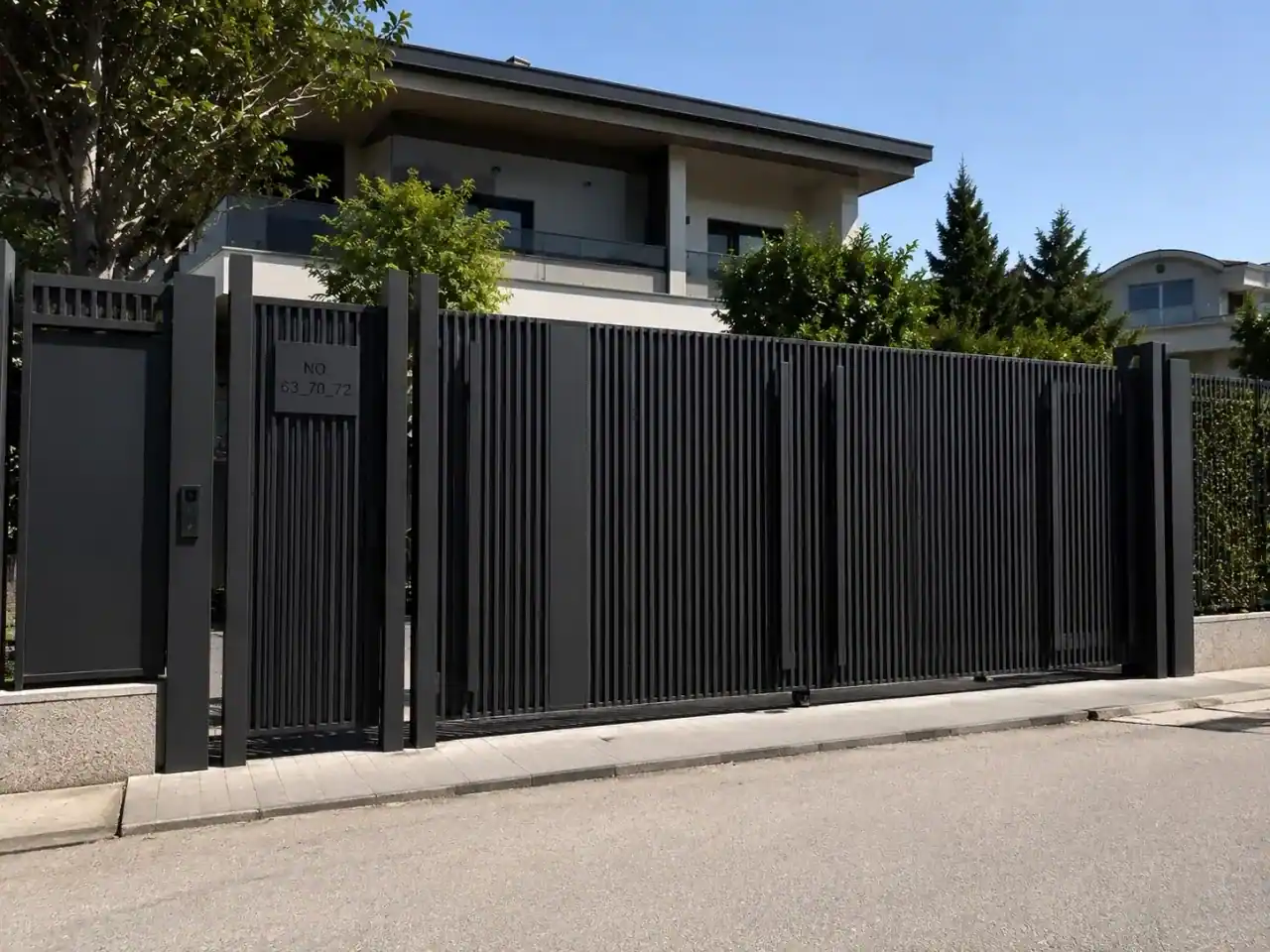
Minimal Cantilever Sliding Villa Gate
Villa Driveway Gates · Matte black (RAL 9005)
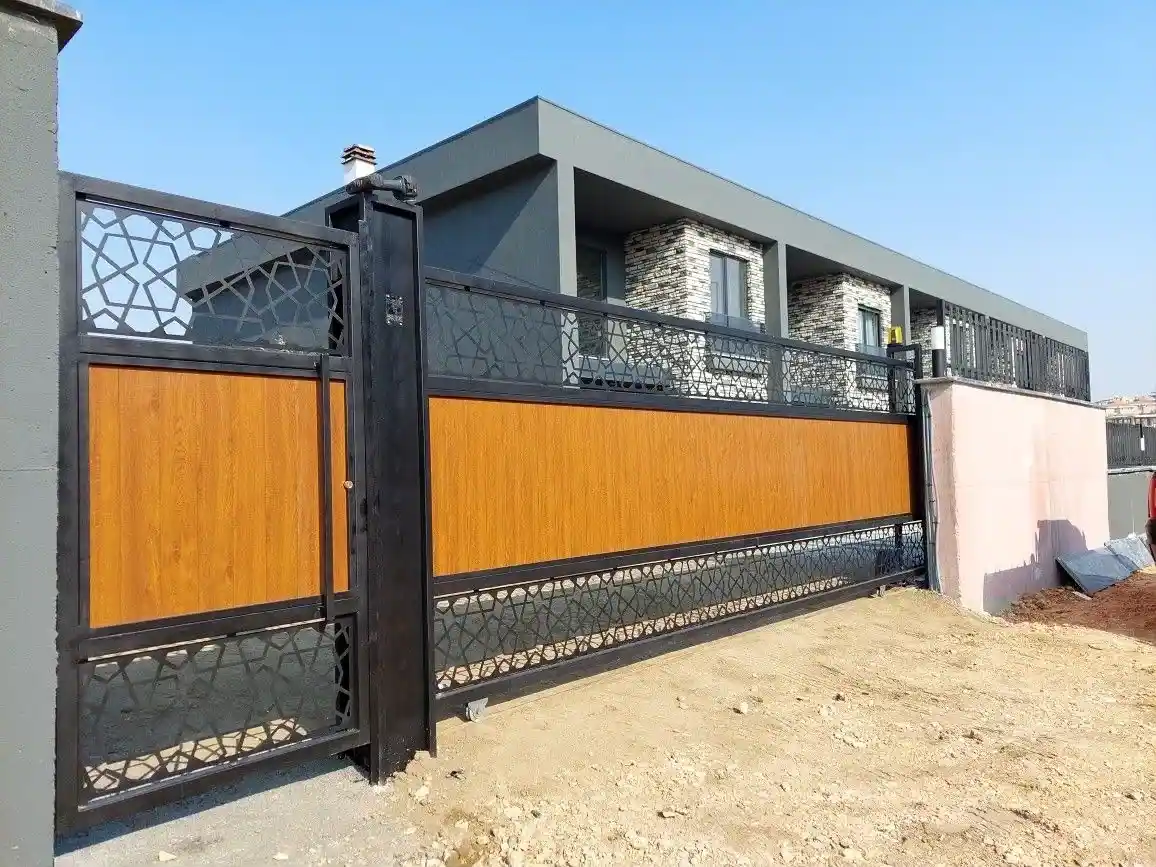
Wood-Look Composite Infill Villa Gate
Villa Driveway Gates · Walnut / teak-pattern composite, anthracite frame

Perforated Laser-Cut Pattern Villa Gate
Villa Driveway Gates · Anthracite, black or Corten effect
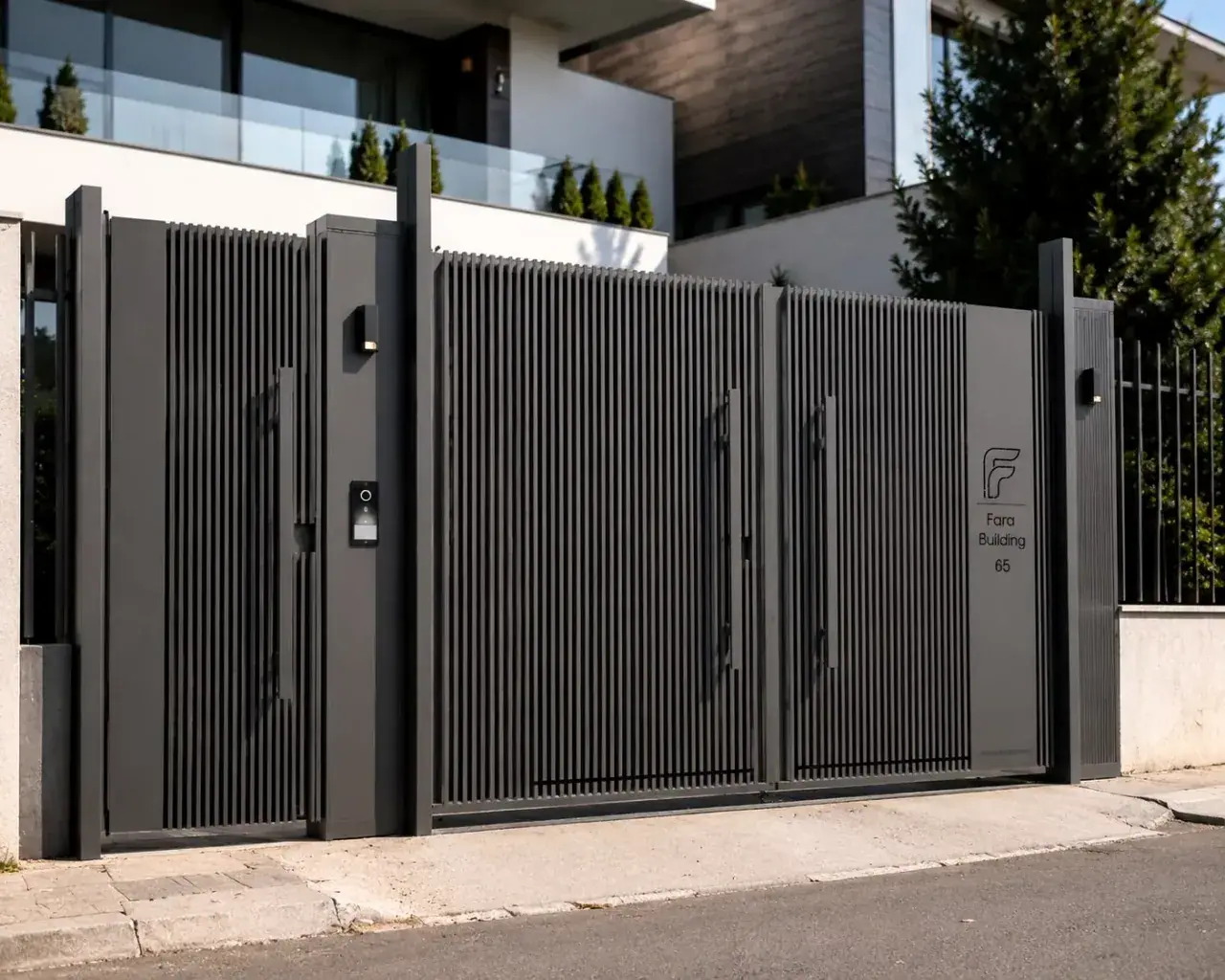
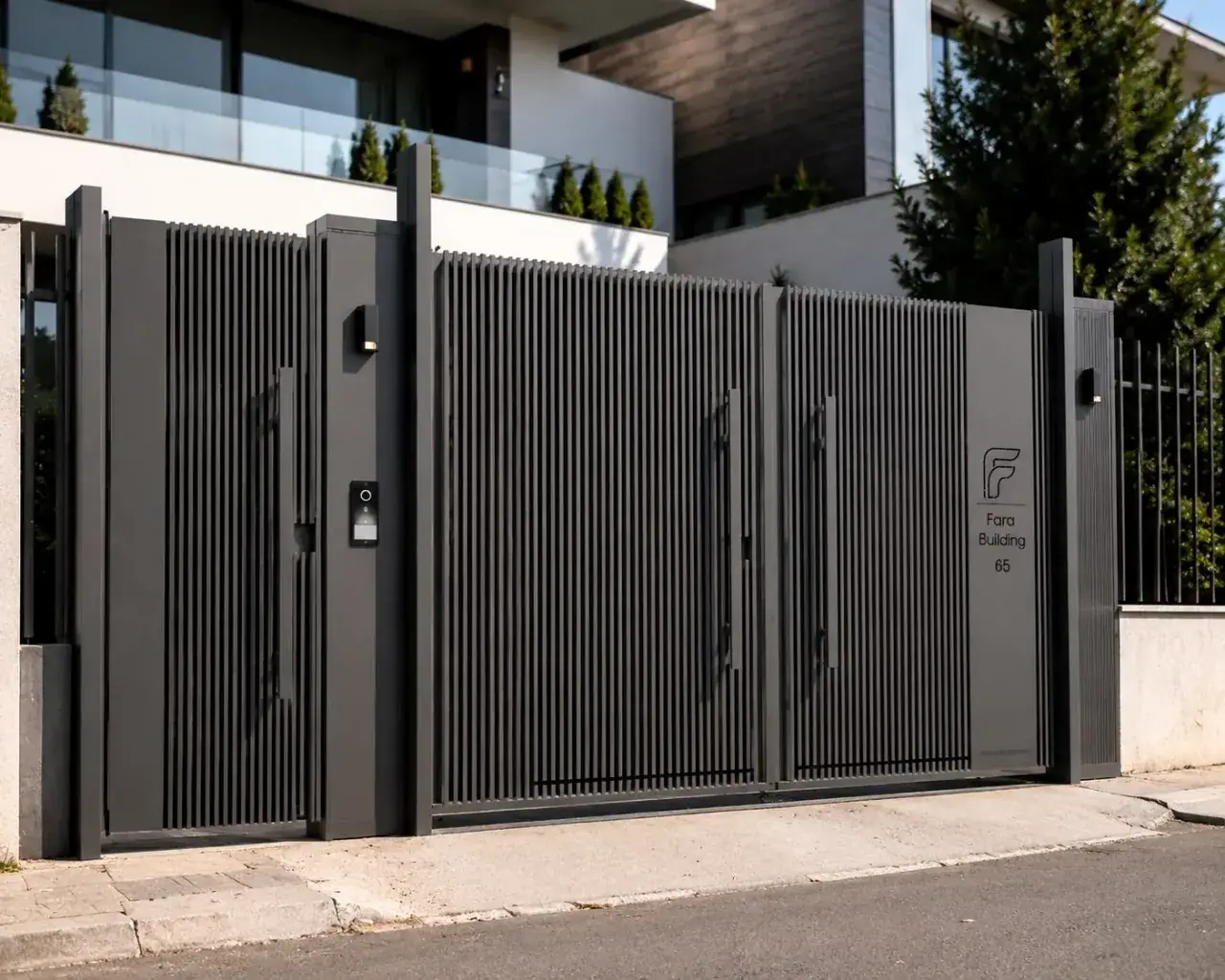
Modern Vertical-Bar Villa Gate
Villa Driveway Gates · Anthracite or matte black
02Definition
What is a villa driveway gate, and where is it used?
A villa driveway gate is a metal structure, made up of a load-bearing frame and infill, that closes the opening left in the garden wall for vehicle access. There are no standard sizes: because every villa differs in its opening, the condition of its columns, the slope of the ground and its relationship to the street, the gate is always fabricated to measurements taken on site. The frame is usually welded from box section, while the infill is chosen from slats, bars, composite panel, perforated sheet or forged iron.
Driveway gates are most often used on villas and detached houses; the same approach also applies to shared entrances in residential complexes, farmhouses and vineyard houses, and the garden entrances of small businesses. A gate’s job is not only to close an opening: it directly shapes how visible the garden is, how the wind enters it and how the house reads from the street. That is why choosing a gate is as much an architectural decision as a security one.
Treating the gate in isolation is the mistake we come across most often in Istanbul. The driveway gate, the pedestrian gate beside it and the wall-top railing are parts of the same line. Ordered separately, the slat spacing does not line up, the paint shades drift apart because they come from different batches, and the entrance looks pieced together after the fact. When we plan all three together, the same section, the same spacing and the same paint batch are used throughout.
03Types
Types of villa driveway gates
The opening type is determined by the free space in front of and beside the gate. Choose the wrong one, and it will be a daily annoyance, however well the gate is made.
Track-mounted sliding gate
The gate slides sideways along the garden wall on a track laid in the ground. Because it needs no maneuvering space in front of or behind it, it is the most convenient solution for narrow streets and ramped entrances. In return, it needs a clear run along the wall for the gate to slide into, and the ground track has to be kept clean; at entrances where snow, sand or leaves collect, the track should be swept regularly.
Cantilever (trackless) sliding gate
The gate is carried clear of the ground on a tail extending to the side and two roller carriages; there is no track on the ground. No threshold forms across the opening, low cars do not catch on it, and snow and leaves cannot jam the gate. On the other hand, it needs additional space to the side of roughly half the gate’s width, and it requires a heavier frame and a more powerful motor.
Double-leaf swing gate
Two leaves open from the center. This is the natural opening type for classic and wrought iron designs, and in large gardens it is visually the most inviting when open. The swing arc of the leaves in front of the gate must be kept clear — it cannot be used at entrances that open onto a narrow street or where cars park right in front of the gate.
Folding gate
Each leaf folds in two, so half the swing arc a double-leaf gate needs is enough. It is chosen for entrances where the opening is wide but the space in front of the gate is limited. More hinges also mean more points that need maintenance.
By infill type
Horizontal slats screen the garden and make the facade look longer; vertical bars keep the garden visible and reduce wind load; composite panel gives the warmth of wood without the maintenance; perforated sheet lets you adjust privacy by degrees through the density of the pattern; forged iron speaks the same language as the architecture on classic facades.
04From the field
Projects we have completed
The photos below show Saray Metal’s own work; they are not illustrative images.
Villa Driveway Gates
Villa driveway gate Villa driveway gate Villa driveway gate Villa driveway gate Villa driveway gate Villa driveway gate
All photos are from Saray Metal’s own projects. Tap a photo to open it uncropped. If you would like to see more, message us on WhatsApp.
05Technical
Materials and technical specifications
The values below are ranges commonly used in the industry. The exact section and wall thickness are determined separately for each project, according to the opening, the gate’s weight, wind load and automation.
| Frame profile | Box section; section size chosen to suit the opening and gate weight |
|---|---|
| Wall thickness | Usually in the 2–3 mm range; increased for wide openings |
| Infill options | Slats, vertical bars, composite panel, perforated sheet, forged iron |
| Track and wheels | Galvanized track, ball-bearing wheels (on track-mounted sliding systems) |
| Surface treatment | Sandblasting + primer + electrostatic powder coating |
| Color | From the RAL chart; anthracite (7016) and matte black (9005) are the most common |
| Automation | Compatible with sliding, cantilever and swing gate motors; can also be added later |
| Size | Fully made to measure — there is no catalog of standard sizes |
06Measurements
Measurement and planning
A rough measurement is enough for a first conversation: measure the distance between the two columns with a tape and send it to us, and that is enough for us to outline the quote. The measurements used for fabrication, however, are always taken on site by us, because what decides whether a gate will work is less the width of the opening than the condition of the ground and the columns.
During the site survey, we look at the clear width and height of the opening, whether the two columns are plumb, the level difference and direction of slope on the ground, the ramp between the street and the garden, the space the gate will slide or swing into, whether the existing columns can carry additional load, and the location of any electrical supply.
Level difference and slope
If the entrance is ramped, the track level causes problems for a track-mounted sliding gate; in that case a cantilever sliding gate comes out ahead. With a double-leaf gate, the slope can make the leaf scrape the ground as it opens.
Column condition
If the existing columns cannot carry the load of the gate and motor, they need to be reinforced. A gate hung on a wobbly column has a column problem, not a gate problem — but the gate gets the blame.
Maneuvering space
The free space in front of the gate directly determines the opening type. An opening-type decision made without this measurement cannot be corrected after installation.
Electrical preparation
If automation is being considered, the power supply line and photocell cables are planned before the gate is fabricated; cables run afterward either end up in a visible conduit or mean drilling into the frame.
07Hardware
Automation and accessories
The motor moves the gate; safety comes not from the motor but from the equipment around it. Of the items below, safety photocells are non-negotiable.
Gate motor
Sliding gates are driven through a gear rack; swing gates use ram (piston) or articulated-arm motors. Power is chosen according to the gate’s weight; an undersized motor struggles on a frozen track in winter and wears out its gear within a few seasons.
Safety photocells
They are placed on either side of the opening and stop the gate from closing when something passes between them. We do not install automation without photocells at any entrance used by children, pets or vehicles.
Warning light and alerts
It gives a visual warning while the gate is moving. Especially at night and at entrances on narrow streets, it noticeably reduces the risk of collision.
Remote controls and remote access
As many remote controls as you need are paired with the receiver, and a lost remote can be deleted individually. With a Wi-Fi module added, the gate can be opened from your phone and every opening is logged.
Power outages
Every motor has a manual release key; the key releases the motor so the gate can be pushed by hand. In locations where outages are frequent, battery backup is planned separately.
08Process
From site survey to handover
Every job goes through the same seven steps. When one of them is skipped, the problem usually shows up not during installation but at the end of the first year.
- 01
Site survey
Measurements are taken on site; we see the opening, level differences, ground conditions and any existing structure. The dimensions on paper almost never match those on site exactly.
- 02
Design and drawings
A technical drawing is prepared from the measurements. Infill divisions, profile sections and any automation layout are finalized at this stage.
- 03
Approval
The drawing and the color and material choices are approved in writing. Because a change after approval means reversing fabrication, this step is not rushed.
- 04
Fabrication
Cutting, bending and welding are done in our workshop in Arnavutköy. Weld seams are ground flush with the surface.
- 05
Surface treatment
The surface is prepared by sandblasting and primed, then electrostatic powder coating is applied. For parts that will stay outdoors, galvanizing comes into play.
- 06
Installation
On site, the work is anchored, aligned and, if needed, welded in place. If there is automation, the electrical connection and photocell adjustment are completed the same day.
- 07
Handover
Operation is checked, and use and maintenance are explained. Remote controls are programmed, locks are handed over and any phone app is set up at this stage.
09Price
What determines the price?
To give you a price, we need the measurements and the location; two gates of the same width can come out noticeably different because their infill and automation differ. The factors below directly affect the quote.
Opening size
As width and height increase, both the material and the load-bearing section grow.
Opening type
A cantilever sliding gate needs a heavier frame and a more powerful motor than a track-mounted sliding gate.
Infill choice
Forged iron and laser-cut patterns involve noticeably more labor than plain slats.
Surface treatment
Sandblasting, primer and electrostatic powder coating are standard; adding galvanizing changes the cost.
Automation
Motor class, photocells, warning light, battery backup and the remote access module are separate items.
Installation conditions
If column reinforcement, ground leveling or running a power line is needed, the scope of the work grows.
10Maintenance
Maintenance and service life
On a gate with the right surface treatment, maintenance comes down to a few simple tasks once a year: sweeping the track, lubricating the wheels and hinges, cleaning the lock cylinder and washing the painted surface with fresh water. In locations exposed to the sea, washing should be more frequent, because salt build-up is the most common way through to the metal beneath the paint.
What really determines service life is the steps skipped during fabrication. On a gate painted without sandblasting, corrosion starts beneath the paint and goes unnoticed from the outside for years; then one day the paint blisters, and the surface underneath turns out to be long gone. That is why we treat surface preparation as the step that cannot be seen but determines how long the gate lasts. For automated gates, we also recommend checking photocell alignment once a year.
11FAQ
Frequently asked questions about Villa Driveway Gates
How are villa gate prices determined?
Six factors decide it: opening size, opening type, infill choice, surface treatment, whether there is automation, and installation conditions. That is why we do not give a price without measurements and location. Measure between the two columns and send it to us on WhatsApp, and we will prepare the quote accordingly.
Should I choose a sliding gate or a double-leaf swing gate?
The free space in front of and beside the gate decides. If there is room in front of the gate for the swing arc and you want a classic look, go for a double-leaf gate; if the street is narrow, the entrance is ramped or cars park in front of the gate, a sliding gate is the right choice. If you do not want a threshold on the ground, a cantilever sliding gate comes out ahead.
Should I take the measurements myself?
A rough measurement is enough for the first quote. We always take the measurements for fabrication on site ourselves; wall plumb, level differences and column condition can only be seen on site, and they almost never match the measurements on paper.
How long do fabrication and installation take?
It depends on the complexity of the model, the surface treatment and how busy the workshop is at the time. We give you a firm date after the site survey; we do not think it right to give an estimate before approval, because a timeframe given before measurements are taken often does not hold.
Can I have a motor fitted to my existing gate?
In most cases, yes. What decides it is the gate’s weight, the condition of the track and hinges, and whether the gate moves easily by hand. A gate that is hard to push by hand will also be hard for a motor to move; the motor does not solve the problem, it takes on the load and wears out sooner. We check the mechanical condition first.
Do I have to order the driveway gate and the pedestrian gate at the same time?
No, but when they are made at the same time, the same profile section, the same infill spacing and the same paint batch can be used. On a pedestrian gate added later, there may be a difference in shade caused by a different batch, even if the same RAL code is used.
My location is windy — will solid infill cause problems?
It can. Solid infill takes far more wind load than open infill of the same size, and that load puts direct strain on the hinges, wheels and motor. In locations exposed to the lodos, the southwesterly wind, either the infill is spaced out or the load-bearing section is enlarged accordingly.
Which colors show dirt the least?
Anthracite gray and dark shades show dust and water spots noticeably less than white and light shades. At roadside entrances, this difference becomes noticeable over the course of a year.
12Guides
Read before you decide
Topics that come up often at the decision stage and fall outside the technical scope of this page.
13Related services
Work often done alongside this


14Service areas
Areas we serve for Villa Driveway Gates
Fabrication takes place in our own workshop in Arnavutköy; delivery and installation are carried out across Türkiye. Each area page describes local conditions and the delivery plan.
14 / Contact
Send us your measurements for Villa Driveway Gates
Approximate measurements and your district are enough for us to outline the quote. Let’s set the best day for the site survey in the same conversation.